

From Streetcars to Storybook Homes: The History of Wileman’s Belle Isle in Oklahoma City
Wileman’s Belle Isle is a predominantly 1950s neighborhood in northwest Oklahoma City, west of Pennsylvania Avenue near Northwest Expressway and Penn Square. Ben Wileman helped develop it, and Dorothy and Luke Rodgers created some of its distinctive Storybook homes. The neighborhood takes its name from the earlier Belle Isle lake and amusement destination nearby.
Today, Wileman’s Belle Isle sits in the heart of Oklahoma City, surrounded by some of the city’s busiest streets, established neighborhoods, shopping and restaurants. Penn Square Mall is just down the road. Northwest Expressway carries thousands of cars past the area every day.
But more than a century ago, getting to Belle Isle meant something entirely different.
You took the streetcar.
Long before Wileman’s Belle Isle became one of Oklahoma City’s most distinctive mid-century neighborhoods, this part of town was near the northern edge of the city. What happened here over the next century tells a surprisingly complete story of Oklahoma City itself: streetcars gave way to automobiles, an amusement park became a power plant, farmland became suburbia, and a husband-and-wife design team created some of the most unusual Storybook homes in OKC.
To understand Wileman’s Belle Isle, we have to go back to the beginning.
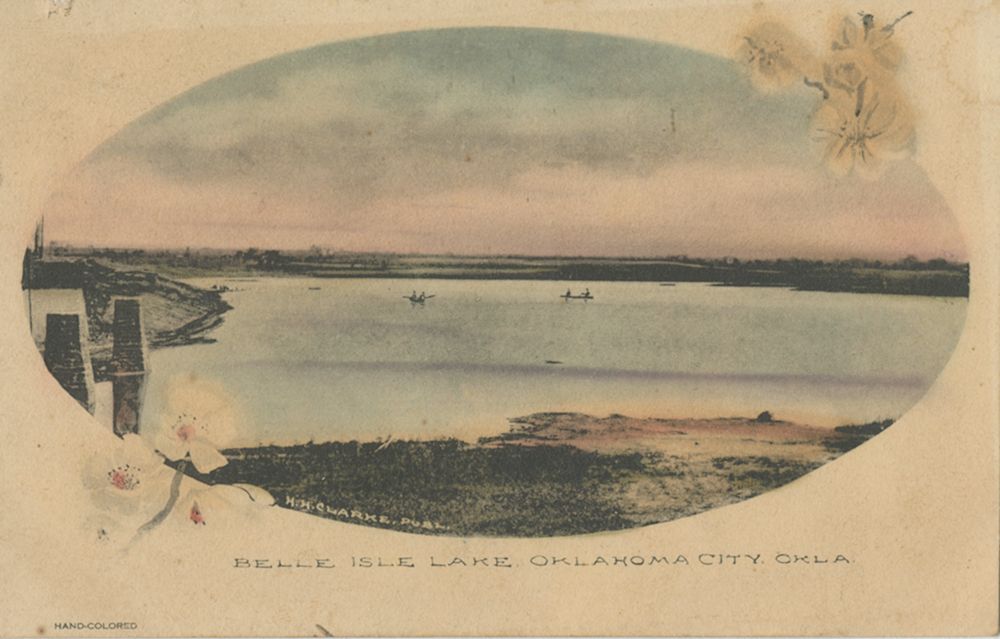
Before the Neighborhood: Belle Isle at the End of the Streetcar Line
In the early 1900s, Oklahoma City was growing rapidly, and two names were particularly important to that expansion: Anton Classen and John W. Shartel.
Classen and Shartel were involved in the Oklahoma Railway Company, which operated Oklahoma City’s electric streetcar system. Classen was also heavily involved in real estate development.
Those two businesses worked remarkably well together.
Extending streetcar lines made undeveloped land more accessible. Development along those lines created new passengers. But there was another problem to solve: streetcars were most useful when people were traveling to and from work or shopping.
What would make people ride them on evenings and weekends?
Give them somewhere to go.
Around 1907 and 1908, the Oklahoma Railway Company developed Belle Isle Lake and an electric generating facility north of the developed city.
And Belle Isle became a destination.
Oklahoma City's Belle Isle Amusement Park
Belle Isle Park opened in 1908 and quickly became one of Oklahoma City’s premier recreational destinations.
For Oklahoma Citians accustomed to a young, rapidly developing prairie city, Belle Isle offered an escape.
Visitors could ride the streetcar north and spend the day swimming, boating, fishing, picnicking and enjoying amusement rides. Historical accounts describe a dance pavilion, carousel, boardwalk and the memorable Honeymoon Bridge.
After Delmar Garden closed in the early twentieth century, Belle Isle became even more important as a recreational destination for Oklahoma City.
It is difficult to picture today.
The intersection of Pennsylvania Avenue and Northwest Expressway is now surrounded by traffic, retail development and neighborhoods. In the early twentieth century, however, riding north to Belle Isle meant leaving much of Oklahoma City behind.
Belle Isle was essentially a recreational getaway in the countryside.
And the streetcar was how you got there.
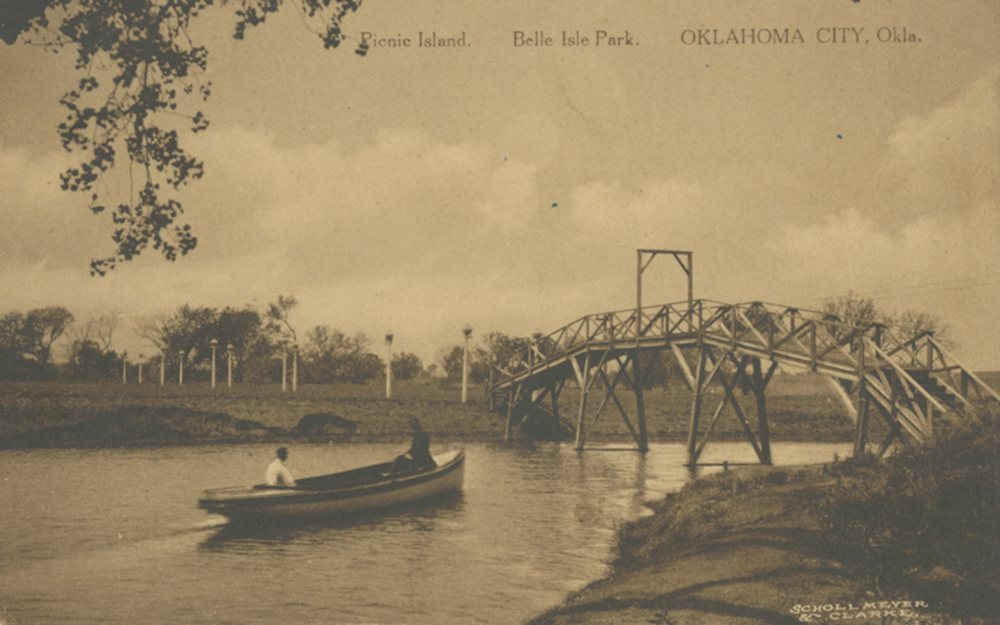
Belle Isle Was Also a Real Estate Strategy
The amusement park was fun, but there was also smart economics behind it.
Streetcar companies across America developed recreational destinations at the ends of their lines because they generated passengers during periods when normal commuter traffic was lighter.
Belle Isle served that purpose in Oklahoma City.
But Anton Classen’s involvement adds another layer to the story.
Classen was both a transportation entrepreneur and a real estate developer. Extending transportation into undeveloped areas made those areas easier to develop and market.
In modern terms, we might call this transit-oriented development.
Build transportation. Create a destination. Bring people into the area. Develop the surrounding land.
Decades before Northwest Expressway and Penn Square transformed this part of Oklahoma City, Belle Isle was already helping pull the city northward.
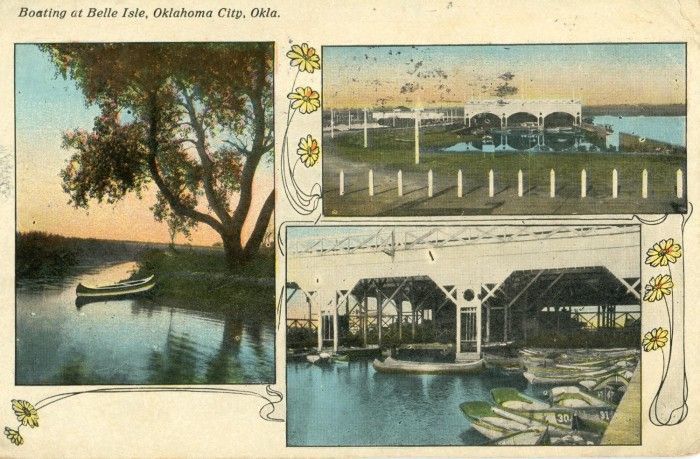
From Amusement Park to Power Plant
The automobile eventually changed the equation.
As car ownership increased, Oklahoma City’s streetcar system became less important. In 1928, the Oklahoma Railway Company sold the Belle Isle property to Oklahoma Gas & Electric.
Around 1930, OG&E constructed a much larger generating station at Belle Isle.
The amusement-park era gradually faded, although parts of the property continued to be used for fishing and picnicking during the 1930s and 1940s.
The enormous Belle Isle power plant became the area's defining landmark.
For decades, its industrial structure stood near the former recreational grounds, producing electricity as Oklahoma City continued expanding around it.
Meanwhile, the land west of Pennsylvania Avenue remained remarkably undeveloped.
That was about to change.
Ben Wileman and the Birth of a Neighborhood
The next chapter belongs to Ben C. Wileman.
Wileman was born in Texas in 1908 and initially worked in the lumber business before moving into homebuilding.
By the 1940s, he was already participating in the enormous transformation occurring in American housing.
World War II had ended. Veterans were returning home. Families were forming. Automobile ownership was increasing. Demand for housing was enormous.
And builders were learning how to construct suburban houses at a scale America had never seen before.
Wileman was one of them.
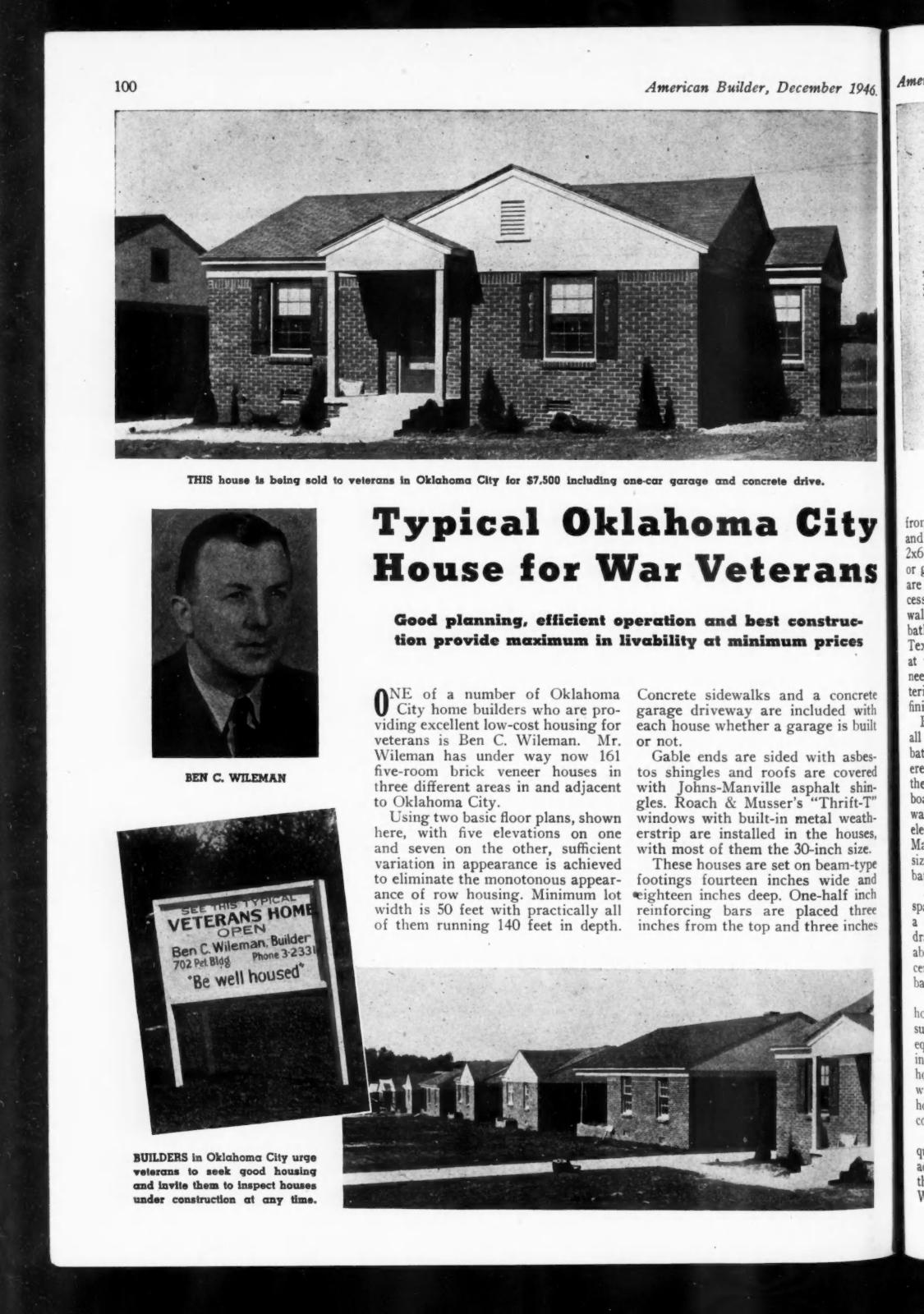
Ben Wileman Was Building Postwar Oklahoma City Before Belle Isle
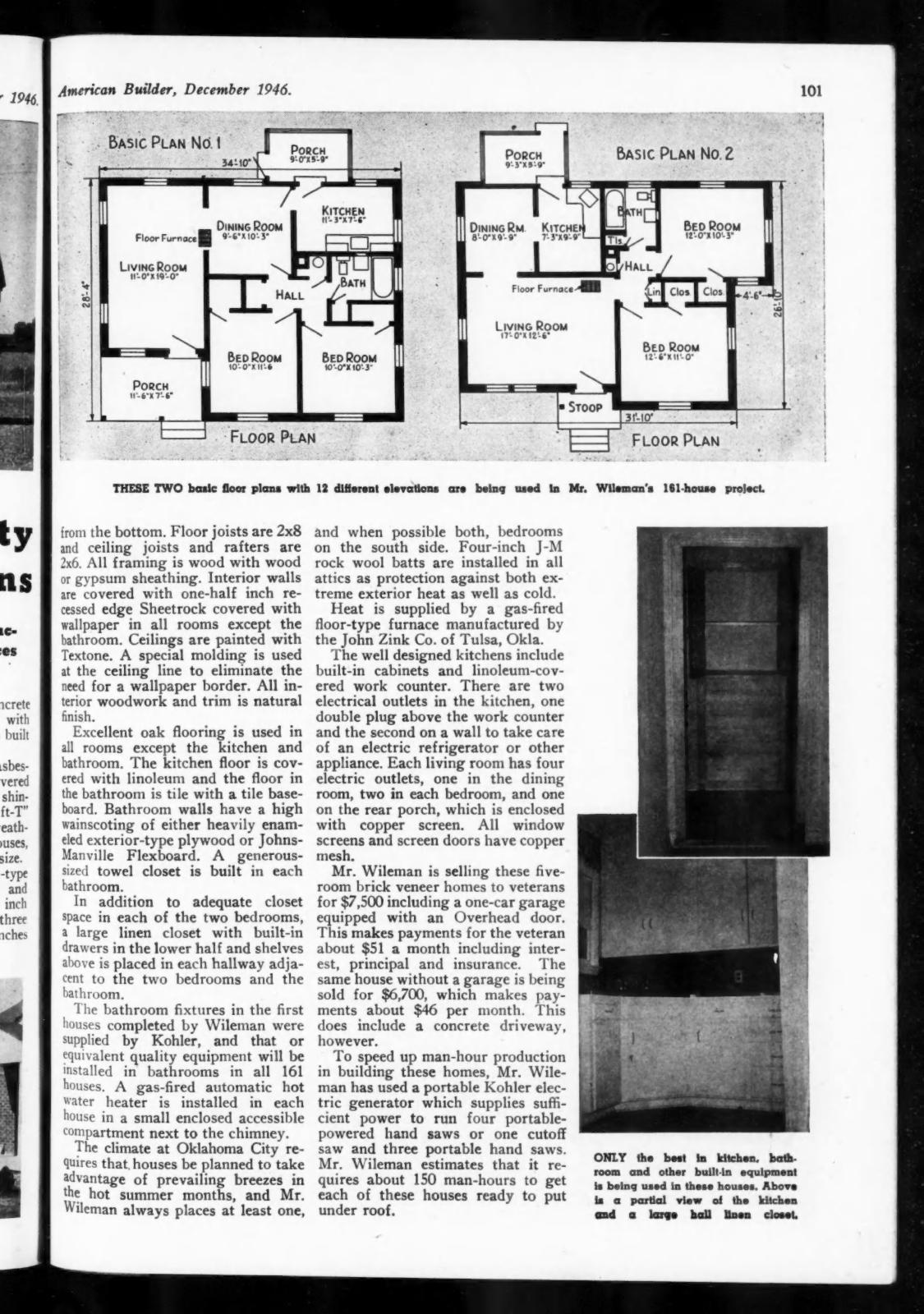
The December 1946 issue of American Builder, pages 100–101 documented Wileman’s Oklahoma City building operation.
At the time, his company had 161 five-room brick-veneer houses under construction in three Oklahoma City areas, many intended for returning veterans.
The houses used a limited number of basic floor plans, but different exterior elevations helped prevent entire streets from looking identical.
One featured Wileman home was advertised at approximately $7,500, including a garage and concrete driveway.
That gives us an important clue about what eventually happened at Belle Isle.
Ben Wileman wasn't simply subdividing land.
He had spent years learning how to build attractive suburban housing efficiently and at scale.
The Oklahoma City Community Foundation’s 1999 annual report credits Wileman’s firm with constructing more than 3,000 homes between 1940 and 1960 in Oklahoma City, Midwest City, El Reno and Elk City.
His development work also included Belle Isle, Windsor Hills, Penn Square and several shopping centers.
By the time he arrived at Belle Isle, Wileman had become one of the people physically shaping postwar Oklahoma City.
Wileman's Belle Isle Begins
Development of what we now know as Wileman's Belle Isle began around the early 1950s.
According to the Wileman’s Belle Isle Neighborhood Association, some of the first houses were constructed between approximately 1950 and 1954, beginning around NW 54th Street and expanding north toward NW 56th Terrace.
Consider what the area looked like then.
Pennsylvania Avenue was essentially a two-lane road.
Land farther west was still agricultural.
The old Belle Isle power plant stood nearby.
Penn Square did not exist.
Northwest Expressway had not yet become the commercial corridor we recognize today.
What now feels like central Oklahoma City was suburbia.
Building Wileman's Belle Isle Addition by Addition
Wileman's Belle Isle wasn't created as one enormous subdivision overnight.
The neighborhood developed through a series of numbered additions.
We can actually see the process happening in contemporary records.
A notice in the September 21, 1956 Daily Law Journal-Record, page 8, solicited construction bids for approximately 11,700 feet of new water mains in Wileman 7th Addition.
The notice named the City of Oklahoma City and Penn Avenue Development, Inc. as the parties receiving bids. It documents planned utilities, rather than the completion date of every home in the addition.
It is an ordinary municipal notice, but historically it is fascinating.
It captures the neighborhood in the act of being built.
Streets were being laid out. Utilities were being extended. Houses were appearing. And Oklahoma City was pushing farther north.
What Did the Original Wileman's Belle Isle Homes Look Like?
Most of the houses reflected the architectural revolution occurring across postwar America.
The ranch house was king.
Low rooflines, broad façades, attached garages and increasingly open living areas reflected a lifestyle built around the automobile and suburban family life.
Inside, these homes embraced the colors and materials of the 1950s.
Pink, peach, mint green, baby blue and yellow.
Colorful tile bathrooms, fireplaces, built-in cabinetry and larger kitchens became common.
Many of these features survive in Wileman's Belle Isle today.
But then something unusual happened.
Very unusual.
Dorothy and Luke Rodgers Bring Fairy Tales to Belle Isle
Around 1956, a husband-and-wife design and construction team began building houses around NW 56th Street and NW 56th Terrace.
Their names were Dorothy and Luke Rodgers.
And their houses looked almost nothing like the ranch homes appearing throughout postwar Oklahoma City.
According to architectural preservation organization OKC Mod, Dorothy and Luke Rodgers were Oklahoma City's only husband-and-wife design/build team during the 1950s.
Dorothy was the creative force behind many of the designs.
Luke translated those concepts into plans and constructed the homes.
Luke's brother, Jack Rodgers, produced custom millwork.
And Dorothy's inspiration reportedly included something wonderfully unexpected:
illustrated children's fairy-tale books.
The Storybook Homes of Wileman's Belle Isle
The resulting houses are difficult to categorize neatly.
They are sometimes called Storybook houses. Others describe them as chalet-inspired or European-influenced.
All of those descriptions make sense once you see them.
Instead of conventional ranch-house symmetry, the Rodgers homes could feature dramatic rooflines, carved wood, unusual shutters, elaborate masonry, stained glass, rounded rooms, distinctive fireplaces and houses positioned unexpectedly on their lots.
The neighborhood association attributes Luke Rodgers’ European influence to a trip overseas and also connects the designs with Disneyland. These are attributed historical accounts, rather than documentation of the inspiration for every individual house.
And then there was another source of inspiration arriving in American culture at exactly the right moment.
Disneyland opened in 1955.
Its romanticized European villages, castles and fantasy architecture captured the American imagination.
Against that cultural backdrop, the Rodgers houses suddenly make more sense.
They were suburban houses designed during an era fascinated with the future, but they borrowed imagery from an imagined European past.
One Remarkable Surviving Example
One of the best-known examples stands at 2204 NW 56th Street.
Property and listing histories date the house to 1957. Earlier real-estate marketing identifies it as a Luke Rodgers Storybook home. These listing descriptions are supporting evidence, not a complete architectural inventory.
Its details include elaborate brickwork, carved wood, stained glass and a rounded fireplace.
Some previous accounts describe seven Rodgers Storybook houses in the area. The figure appears in syndicated property marketing, which can repeat the same original description. It is not an independently verified count; a complete inventory of the Rodgers houses is still needed.
Regardless of the exact number, their architectural impact is unmistakable.
Drive through Wileman's Belle Isle and suddenly a house appears that looks as though someone dropped an Alpine cottage or fairy-tale house into a 1950s Oklahoma subdivision.
That contrast is part of what makes the neighborhood special.
Then Penn Square Changed the Neighborhood Again
Another major transformation arrived in 1960.
Penn Square opened nearby as an open-air shopping center, initially anchored by major retailers including John A. Brown and Montgomery Ward.
Its arrival reflected a much larger change happening across America.
Retail was following families into the suburbs.
The old model of traveling downtown for major shopping trips was increasingly competing with large suburban shopping centers surrounded by parking.
Belle Isle had once been built around the streetcar.
Wileman's Belle Isle was built around the automobile.
Penn Square was the logical next step.
Homes, roads and shopping were now being designed around a population that increasingly traveled by car.
Belle Isle Library Adds Another Mid-Century Landmark
Three years after Penn Square opened, the neighborhood gained another important piece of architecture.
Belle Isle Library opened on September 29, 1963.
The building was designed by architect Jack Mills of Turnbull & Mills, a University of Oklahoma architecture graduate who had studied under the legendary Bruce Goff.
That influence can still be seen in the building.
Its pleated concrete roof, Arkansas golden limestone, unusual geometry and relationship to the sloping site make Belle Isle Library much more than an ordinary neighborhood branch library.
It is another physical artifact of the remarkable period when this portion of Oklahoma City was taking shape.
Within only a few blocks, you could now find traditional postwar ranch homes, fantastic Rodgers Storybook houses, modern commercial development and an architecturally ambitious public library.
What Happened to the Belle Isle Power Plant?
The power plant that had dominated the area for generations eventually became obsolete.
OG&E retired the Belle Isle generating station in 1980.
The enormous structure remained standing for nearly another two decades.
The Metropolitan Library System’s history dates demolition of the later OG&E plant to January 1999. The earlier Oklahoma Railway Company plant had been demolished in 1960.
The site was eventually incorporated into the commercial development we now recognize as Belle Isle Station.
Another physical connection to old Belle Isle had disappeared.
But the name survived.
Ross Park Becomes Belle Isle Park
Even today's Belle Isle Park has its own unexpected history.
According to Oklahoma City’s park history, the park was created in 1954 as Ross Park, named for nearby Ross Avenue. This is a different park from the original streetcar-era amusement grounds.
It once included a swimming pool and served the growing residential neighborhoods surrounding it.
Then, in 2013, a devastating ice storm destroyed nearly all of the park's trees.
Residents from Belle Isle and Belle Isle West worked with Oklahoma City Parks and local organizations to restore the park.
As part of that renewed community interest, residents petitioned Oklahoma City to recognize the area's history.
In 2015, Ross Park officially became Belle Isle Park.
More than a century after Oklahoma Citians first boarded streetcars bound for Belle Isle, the historic name had returned to a neighborhood park.
Belle Isle Oklahoma City History: A Timeline
The residential neighborhood and the earlier amusement grounds represent different chapters of the same area’s history.
| Date | What changed |
|---|---|
| 1907–1908 | Belle Isle lake, power facilities and recreation emerge during the streetcar era. The Metropolitan Library dates the amusement park opening to 1908. |
| 1928 | Oklahoma Railway Company sells the Belle Isle property to OG&E. |
| 1930 | OG&E builds the larger Belle Isle generating station. |
| c. 1950–1954 | The neighborhood association dates the earliest Wileman homes to this period. |
| 1954 | Ross Park is established, later becoming today’s Belle Isle Park. |
| 1956 | Rodgers Storybook construction appears in the neighborhood; a September notice seeks bids for Wileman 7th Addition water mains. |
| 1960 | Penn Square opens as an outdoor shopping center. |
| September 29, 1963 | Belle Isle Library celebrates its grand opening. |
| 1980 | The later Belle Isle generating station is retired. |
| January 1999 | The later power plant is demolished. |
| 2015 | Ross Park is renamed Belle Isle Park. |
Then Oklahoma City kept growing. What had been the suburban edge became part of the established city.
Wileman's Belle Isle Today
Today, Wileman's Belle Isle occupies one of the more convenient locations in the Oklahoma City real estate market.
But location isn't the only reason the neighborhood remains interesting.
Its streets contain layers of architecture that are increasingly difficult to reproduce.
There are classic ranch houses with broad lots and mature trees. There are houses retaining original mid-century details. And then there are those remarkable Storybook homes that seem completely unlike anything surrounding them.
Some houses have been extensively renovated.
Others still contain pink tile, original cabinetry, fireplaces and other details installed when Eisenhower was president.
That variety is part of the neighborhood's identity. For buyers comparing OKC mid-century homes, the useful questions are about each home’s architecture, original details and later alterations. Will Flanagan Realty Group can help you explore the neighborhood and its homes with that context in mind.
And once you know its history, the neighborhood looks different.
A quirky house isn't simply quirky anymore.
The streets aren't simply another collection of mid-century OKC homes.
They're remnants of the period when Oklahoma City was reinventing itself.
From Streetcars to Storybook Homes
More than a century ago, Oklahoma Citians traveled north to Belle Isle because it was somewhere to escape the city.
Today, you could hardly describe it that way.
The city caught up.
Then it surrounded it.
The streetcars disappeared. The amusement park disappeared. The lake changed. The enormous power plant eventually came down. Farms became neighborhoods. Two-lane roads became major thoroughfares.
But Belle Isle remained.
And tucked behind the traffic of Northwest Expressway and Pennsylvania Avenue is a neighborhood that still preserves pieces of nearly every chapter.
Wileman's Belle Isle isn't simply a collection of interesting mid-century houses. It is a physical record of how Oklahoma City grew.
And perhaps the best part is that much of that history is still hiding in plain sight.
Wileman’s Belle Isle History: Frequently Asked Questions
What is Wileman’s Belle Isle?
Wileman’s Belle Isle is a predominantly 1950s residential neighborhood in northwest Oklahoma City. Its architecture includes ranch houses and distinctive Storybook designs by Dorothy and Luke Rodgers. It is west of the former Belle Isle lake and amusement grounds.
When was Wileman's Belle Isle developed?
Residential development began in the early 1950s, with some of the first homes constructed around 1950-1954. The neighborhood expanded through several numbered Wileman additions during the decade.
Who was Ben Wileman?
Ben C. Wileman was an Oklahoma homebuilder and developer who helped shape postwar Oklahoma City. His company constructed more than 3,000 homes between roughly 1940 and 1960 and participated in developments including Belle Isle and Windsor Hills.
What was the original Belle Isle in Oklahoma City?
The original Belle Isle was a lake, amusement park and recreational destination developed around 1907-1908 near the end of Oklahoma City's streetcar line. Visitors came for swimming, boating, fishing, picnics, dancing and amusement attractions.
Who designed the unusual Storybook houses in Wileman's Belle Isle?
Dorothy and Luke Rodgers were responsible for some of the neighborhood's most distinctive houses. Dorothy developed many of the creative concepts, Luke translated them into plans and built the houses, and Luke's brother Jack Rodgers contributed custom millwork.
How many Rodgers Storybook homes are in Wileman’s Belle Isle?
The exact number has not been independently verified. Earlier marketing for 2204 NW 56th Street describes it as one of seven, but syndicated listings can repeat a single source. Seven should be treated as a reported figure, not a definitive count.
Why do some Belle Isle homes look like European cottages?
The Rodgers designs incorporated Storybook and European influences. Historical accounts connect their designs with Dorothy Rodgers' interest in fairy-tale illustrations, Luke Rodgers' exposure to European architecture and the fantasy architecture becoming popular in America during the 1950s.
Is Wileman's Belle Isle a mid-century neighborhood?
Yes. Much of Wileman's Belle Isle was developed during the 1950s, making ranch, mid-century and Storybook architecture important parts of its character.
What happened to the old Belle Isle power plant?
OG&E retired the generating station in 1980. The structure remained until 1999, when it was demolished. The area was subsequently redeveloped and is associated today with Belle Isle Station.
Where is Wileman's Belle Isle in Oklahoma City?
Wileman's Belle Isle is in northwest Oklahoma City near Pennsylvania Avenue, Northwest Expressway, Penn Square and Belle Isle Park.
Is today’s Belle Isle Park the original amusement park?
No. Today’s neighborhood park began as Ross Park in 1954 and was renamed Belle Isle Park in 2015. The original Belle Isle amusement destination opened in 1908 near the lake and power facilities by today’s Pennsylvania Avenue and Northwest Expressway area.
Sources and Further Reading
This article distinguishes contemporary records, institutional histories, neighborhood accounts and later property marketing. Approximate dates remain approximate. The number of Rodgers Storybook houses is not presented as settled fact. “Historic neighborhood” describes the area’s history and does not assert a formal historic-district designation.
- Metropolitan Library System: Belle Isle Park
- Metropolitan Library System: Streetcars in Oklahoma City
- Wileman’s Belle Isle Neighborhood Association: History
- American Builder, December 1946, pp. 100–101, digitized by USModernist
- Oklahoma City Community Foundation, 1999 annual report: Ben C. and Addie Mae Wileman
- Daily Law Journal-Record, September 21, 1956, p. 8, via the Gateway to Oklahoma History
- OKC Mod: Dorothy and Luke Rodgers
- OKC Mod: A Charming Storybook in Belle Isle
- Earlier property marketing for 2204 NW 56th Street, reproduced on Zillow
- Metropolitan Library System: Belle Isle Library
- City of Oklahoma City: Belle Isle Park
Categories
Recent Posts








GET MORE INFORMATION

Managing Partner | Realtor License ID: 183611
+1(405) 784-6580 | will@willflanaganrealty.com